

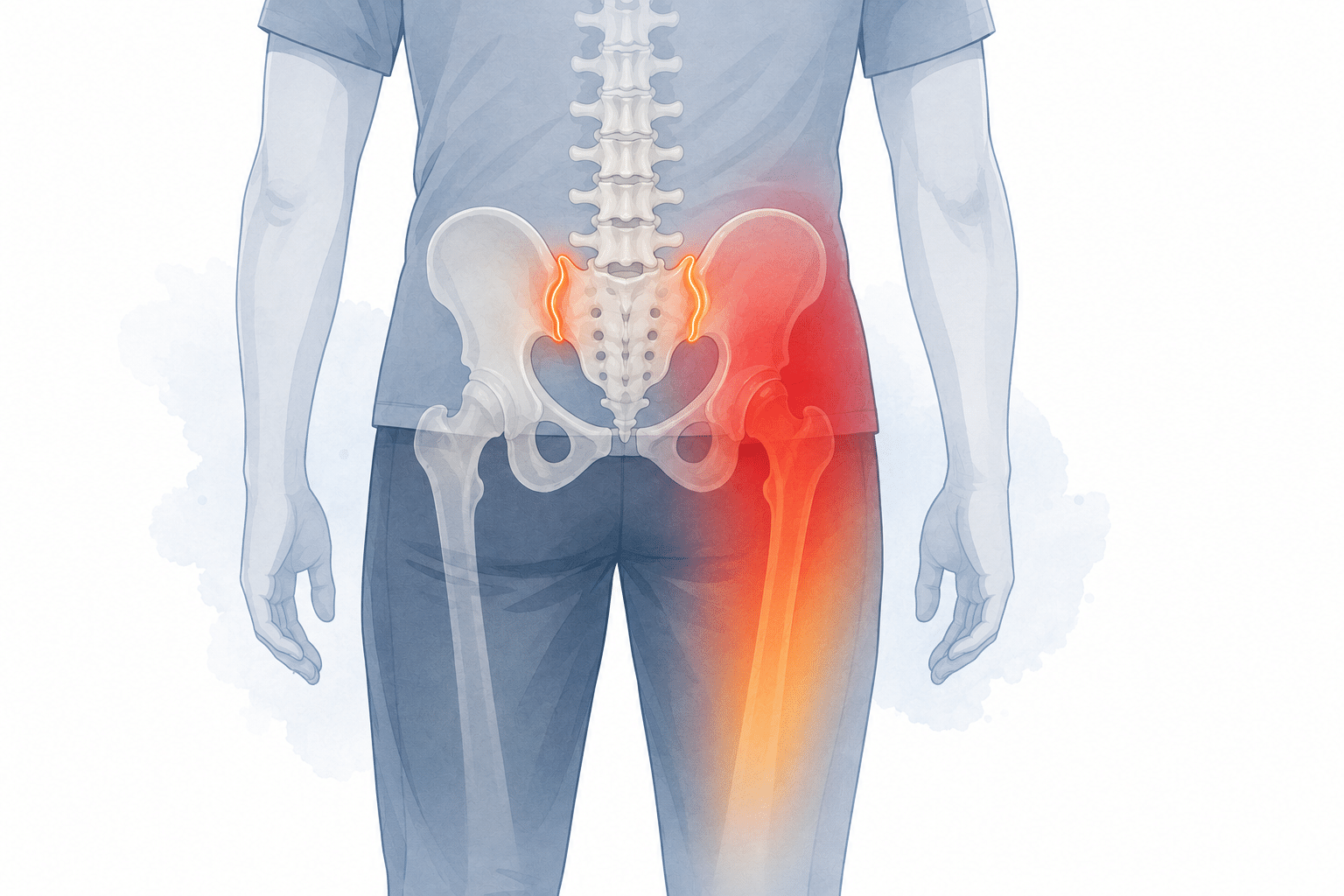
If you’re dealing with pain in your lower back, the source could be your Sacroiliac Joint. Because the SI joint sits at the crossroads of the spine and pelvis, problems here can produce hip pain, lower back pain, or both at once. Recent research estimates that the sacroiliac (SI) joint is responsible for 15–30 percent of cases of low back pain.
The tricky part is that SI joint pain can stem from a wide range of causes, from arthritis and inflammation to pregnancy-related changes, muscle strain, or a sports injury. Understanding why the SI joint is so often involved is the first step toward finding the right treatment to relieve hip and lower back pain effectively.
What Is the SI Joint?
The sacroiliac joint sits on each side of the lower spine, connecting the sacrum (the triangular bone at the base of the lumbar spine) to the ilium of the pelvis. Unlike more mobile joints such as the hip joint or knee, the SI joint moves very little. Its main role is to absorb shock and transfer force between the upper body and the leg on each side.
Strong ligaments and deep stabilizing muscles — including the piriformis muscle, hip muscles, and parts of the abdominal muscles — hold the SI joint in place and connect to the lower back muscles. When any of these supporting structures are strained, weakened, or inflamed, the SI joint can become a significant source of pain. Because nerves from the lower spine also pass near this area, SI joint problems can send discomfort radiating into the hips, thigh, left leg, or even down toward the right ankle.
What Causes SI Joint Pain?
SI joint pain can stem from many different causes. Some of the most common include:
- Arthritis: Osteoarthritis can gradually wear down the cartilage in the SI joint, while inflammation can cause chronic pain and stiffness in and around the joint.
- Sacroiliitis: Inflammation of the SI joint itself can produce deep aching in the lower back and hips.
- Hypermobility or instability: When the ligaments supporting the SI joint become too loose, the joint may move more than it should. This is especially common during and after pregnancy, when hormonal changes relax pelvic ligaments.
- Hypomobility or stiffness: On the other end of the spectrum, the SI joint can become too stiff or restricted, often due to age-related degeneration or prolonged inactivity.
- Injury or trauma: A fall, car accident, or sports injury can damage the joint or its supporting ligaments directly.
- Muscle imbalance: Weak abdominal muscles, tight hip flexor muscles, or tension in the piriformis muscle can alter the way force is distributed across the pelvis and create an uneven pelvic tilt, placing extra load on one SI joint.
- Leg length discrepancy: When one leg is shorter than the other, even by a small amount, it can change the way you walk and shift weight unevenly through the pelvis. Over time, this altered biomechanics can place extra stress on the SI joint and contribute to pain and dysfunction.
How SI Joint Pain Feels
Because the SI joint is connected to so many structures, the pain it produces can show up beyond the location of the joint itself. Common symptoms may include:
- Deep aching in the lower back on one side, often near the beltline or in the hip
- Pain in the buttock, inner thighs, or the front of the thigh
- Stiffness or discomfort when standing up from a chair or getting out of bed
- Pain that worsens with prolonged standing, walking, or climbing stairs
- A feeling of tension or muscle strain that radiates into the leg
- Difficulty finding a comfortable sitting position, especially with a pelvic tilt to one side
Because these symptoms overlap with conditions of the lumbar spine, hip joint, and even a herniated disc, a careful evaluation from a licensed doctor or pain management specialist is essential for identifying the true source.
How Is SI Joint Dysfunction Diagnosed?
Diagnosing sacroiliac (SI) joint dysfunction involves several steps to determine whether the SI joint is truly the source of your pain.
1. Review of Your Symptoms and Medical History
Your provider will discuss where your pain is located, when it occurs, what activities make it worse, and whether you’ve experienced an injury, pregnancy, prior spine surgery, or other conditions that may contribute to SI joint dysfunction.
2. Physical Examination
Your provider will evaluate your posture, gait, strength, and range of motion. They will also perform a series of gentle movement and stress tests that help identify whether the SI joint is reproducing your symptoms.
3. Diagnostic Imaging
X-rays, CT scans, or MRI may be recommended to rule out other conditions affecting the lower back, hips, or pelvis. While imaging can identify arthritis, inflammation, or structural changes, it cannot always confirm that the SI joint is the source of pain.
4. Diagnostic SI Joint Injection
If your symptoms and exam suggest SI joint dysfunction, your provider may recommend a diagnostic SI joint injection. During this minimally invasive procedure, a local anesthetic is precisely injected into the joint using imaging guidance. If your pain is significantly relieved immediately afterward, it confirms that the SI joint is the source of your symptoms.
How to Relieve Hip and Lower Back Pain from the SI Joint
The right approach to relief depends on what’s causing the SI joint pain in the first place. Treatment options range from self-care strategies to minimally invasive procedures.
Conservative and At-Home Approaches
The right pillow can be just as important as your sleeping position when it comes to supporting proper spinal alignment and reducing discomfort. Here’s what to consider:
- Gentle stretching: A daily routine that includes a hamstring stretch, hip flexor stretch, and piriformis stretch may help ease tension around the joint. Keeping the right knee or left knee gently bent during a stretch can help protect the lower spine.
- Strengthening exercises: Core and pelvic stabilization exercises that target the abdominal muscles and hip muscles may improve the support around the SI joint. One clinical trial found that stabilization exercises significantly reduced pain and improved function in patients with SI joint pain.
- Physical therapy: A physical therapist can create a personalized program that addresses underlying muscle imbalance, poor posture, and movement habits contributing to pain.
- Heat and cold therapy: Alternating between ice and heat may provide temporary pain relief and help manage muscle tension or inflammation.
Medical and Interventional Treatment Options
When conservative care isn’t enough, several medical treatment options may help:
- SI joint injections: A corticosteroid and anesthetic injection delivered under fluoroscopic guidance can provide targeted pain relief.
- Radiofrequency ablation: This minimally invasive procedure uses heat to disrupt the nerves carrying pain signals from the SI joint, potentially offering longer-lasting relief.
- Medications: Depending on the underlying cause, anti-inflammatory medications or other targeted therapies may be recommended as part of a broader treatment plan.
When to See a Specialist
While a gentle stretch routine and exercise may be enough for mild discomfort, certain signs suggest it may be time for professional evaluation:
- Chronic pain in the lower back and hip lasting more than a few weeks
- Stiffness or discomfort that limits walking, sitting, or sleep quality
- Pain radiating into the right leg, left leg, or bent knee area
- A history of sports injury, arthritis, or spinal stenosis alongside hip and back symptoms
- Previous stretching or over-the-counter pain relief that hasn’t provided lasting improvement
Board-certified anesthesiologist Dr. Anjum Bux has more than 20 years of experience helping patients identify the true source of their pain. At Bux Pain Management, the approach focuses on a comprehensive evaluation followed by nonsurgical, minimally invasive treatment options personalized to each patient — with the goal of decreasing the frequency and intensity of pain, improving mobility, and restoring quality of life.
If you live in Kentucky, contact Bux Pain Management today to schedule an evaluation.